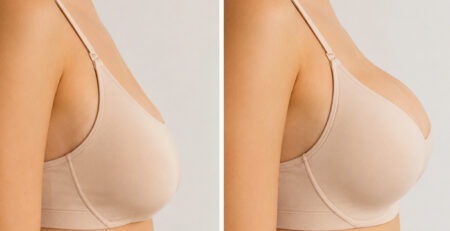
How many sizes are reduced in breast reduction surgery?
One of the most frequently asked questions by individuals researching breast reduction surgery is, “How many sizes are reduced in breast reduction surgery?” Especially in cases where large and heavy breasts make daily life difficult, patients may wonder if they can transition from a D cup to a C cup, an E cup to a C cup, or to a smaller bra size after the operation.
Short answer: In breast reduction surgery, there is no fixed rule of “1 size,” “2 sizes,” or “3 sizes” reduction that can be applied to everyone. While a significant volume reduction can be achieved in some patients, a more limited reduction may be planned for others. The goal is not merely to reach a specific bra letter; it is to create a breast structure that is appropriate for the patient’s body proportions, sufficiently lightened, contoured, and surgically safe.
Moreover, since bra cup sizes can vary even among brands, evaluating the surgical outcome merely as “you will be a B cup” or “you will reduce by two cup sizes” can be misleading. Therefore, realistic outcome expectations can only be formed by a combined assessment of personal examination, breast volume evaluation, chest measurements, skin structure, degree of ptosis, and the tissue planned for removal.
At Op. Dr. Şükrü İşler Aesthetic Clinic, the first examination or consultation is free. Individuals considering breast reduction surgery can discuss their current breast structure, desired reduction amount, and realistic potential outcomes with the doctor in detail during this consultation.
How Many Sizes Are Reduced in Breast Reduction Surgery?
The number of sizes reduced after breast reduction surgery varies from person to person. The same amount of reduction is not expected in a patient with a very large initial breast size compared to a patient with moderately large breasts.
In practice, significant volume changes corresponding to one or several cup sizes can be observed after surgery. However, the most important point here is that “number of cup sizes” and “amount of tissue removed during surgery” do not mean exactly the same thing.
For example, two different patients using an 80E bra before surgery may have different breast volumes, chest widths, breast bases, and proportions of fat and glandular tissue. Removing the same amount of tissue may not result in the same bra size for these two individuals.
Therefore, the goal in plastic surgery is often more comprehensive than a specific letter:
- Balancing the proportion of the breasts to the body,
- reducing excessive breast weight,
- reshaping breast tissue,
- correcting ptosis as much as possible,
- repositioning of the nipple and areola,
- assessment of existing differences between the two breasts,
- and balancing the individual’s expectations with safe surgical limits.
For more detailed information about the basic features of breast reduction surgery, you can review the Breast Reduction page.
Is It Possible to Go From a D Cup to a B Cup?
Questions such as “Can I go from a D cup to a B cup?”, “Can an E cup breast become a C cup?”, and “Can I reduce my breasts as much as possible?” are quite frequently brought up during initial consultations.
Theoretically, if the initial volume is sufficient, a significant reduction can be achieved. However, the achievable result is not solely determined by the patient’s preference.
Some of the key factors evaluated by the surgeon include:
- Current breast volume,
- width of the breast base,
- rib cage structure,
- current position of the nipple,
- distance the nipple needs to be moved to its new position,
- skin elasticity and quality,
- distribution of fatty tissue and mammary gland,
- degree of ptosis (sagging),
- asymmetry between the two breasts,
- patient’s height and overall body proportions,
- tissues and circulation that must be safely preserved.
Therefore, while it may be possible for one patient to go from a D cup to a B cup, the same goal may not be suitable for another patient due to anatomical or surgical reasons. This decision cannot be made online merely by stating the current bra size.
Why Can a Specific Cup Size Not Be Guaranteed After Breast Reduction?
One of the most important details of this topic is that bra sizes are not as standard as believed.
Academic studies have shown that a significant portion of bras used by women may not be of the correct size, and there can be differences in the evaluation of cup sizes. The bra fit research published on PubMed on this topic is one of the studies revealing that the bra size used by breast reduction candidates may not always accurately reflect the true anatomical volume.
More recent research also shows that there can be significant variations in cup volumes among different manufacturers. Therefore, while the approach “I am currently an E cup, and I definitely want to be a C cup after the surgery” is useful for conveying the goal, it is not a reliable way to measure the surgical outcome on its own.
Scientific publications investigating cup size in breast reduction outcomes also emphasize that it is difficult to absolutely promise a specific size. The Reduction Mammaplasty and Cup Size study directly examines this topic.
What Do the Number and Letter in Bra Size Mean?
It is not correct to only look at the cup letter in a bra size. For example, 75D and 90D do not necessarily refer to the same breast volume. The number in a bra size is related to the under-bust circumference, while the letter is related to the difference between the bust circumference and the under-bust circumference.
Therefore, “D cup” alone is not sufficient to describe a person’s actual breast size.
The D cup volume of a woman with a narrow rib cage may differ from the D cup volume of another woman with a wider rib cage. This also makes it difficult to predict the expected cup size change after breast reduction.
Therefore, it is important to consider direct anatomical measurements rather than bra labels during the pre-operative evaluation.
How Much Tissue is Removed in Breast Reduction Surgery?
The amount of tissue removed in breast reduction surgery is not standard. During the operation, an appropriate amount of excess skin, fat tissue, and glandular breast tissue is removed, and the remaining breast tissue is reshaped.
The amount to be removed may vary depending on the patient’s initial size and the operation goals. While a removal of a few hundred grams may be sufficient for some patients, higher amounts may be necessary for extremely large breasts.
Various methods have been investigated in scientific publications to estimate the weight of tissue removed in breast reduction operations pre-operatively. For example, an academic study evaluating resection weight in breast reduction, demonstrates that the amount of tissue removed can vary widely depending on the initial breast size.
However, removing more tissue does not automatically mean a more successful surgery. The goal is not to reduce the patient to the smallest possible size, but to achieve a safe and proportionate reduction.
How Many Sizes Does the Removed Gram Amount Equal?
Searches like “How many sizes does removing 500 grams reduce?” or “How many cups does 1 kilogram of breast tissue equal?” are made online. However, medically, there is no fixed conversion formula between grams and cup sizes that can be applied to everyone.
This is because the shape of the breast tissue, the base width, the rib cage, excess skin, and the sizing methods of bra manufacturers differ.
There are academic models that try to predict this relationship. For example, the scientific study titled Reduction Mammaplasty: What Cup Size Will I Be? investigated a method to estimate the tissue weight planned to be removed from the initial and targeted cup size.
These studies can assist in clinical evaluation; however, they do not guarantee a specific bra brand or cup size for an individual patient before surgery.
Is the Goal in Breast Reduction to Go Down to the Smallest Size?
No. The goal of breast reduction surgery is not always to create the smallest possible breast.
In the planning of the operation, function, preservation of nipple circulation, breast shape, and the person’s body proportions are as important as aesthetic appearance.
For example, a very small breast volume may not always look natural or balanced on a person with broad shoulders and a wide rib cage. In another person with a narrower torso structure, a smaller volume might be more harmonious with their body proportions.
Therefore, the second question that should be asked immediately after “how many sizes will it be reduced by?” is actually this:
“What is the appropriate amount of reduction for my body type?”
To examine the general planning principles of breast aesthetics, you can check out the Breast Aesthetics page.
Are Breast Reduction and Breast Lift Performed at the Same Time?
In breast reduction surgery, while the volume is reduced, the shape of the breast is also reshaped. Since large breasts often have sagging, repositioning the nipple to a more appropriate position and adjusting excess skin may be part of the operation plan.
However, for individuals who only have sagging and do not wish to significantly reduce breast volume, the primary need may be different. Therefore, breast reduction and breast lift are not the same concept.
Whether breast volume needs to be reduced, or if the main problem is sagging, should be determined by personal examination. For detailed information on this topic, you can review the Breast Lift page.
Do Breasts Appear Firmer After Breast Reduction?
In breast reduction surgery, not only is the volume reduced, but the remaining breast tissue is also reshaped. Therefore, in suitable patients, breasts may appear smaller and more lifted after the surgery.
However, the outcome varies depending on the individual’s initial anatomy, skin quality, surgical technique, and healing process.
In the long term, aging, gravity, weight changes, pregnancy, and hormonal changes can affect breast shape again. Therefore, the surgical outcome should not be considered a completely unchangeable structure.
What Measurements Are Taken in Breast Reduction?
In the initial evaluation, only the current bra size is not asked. For surgical planning, breast and chest wall anatomy are evaluated together.
Measurements and features that can be evaluated may include:
- Distances between the nipple and anatomical points on the chest,
- the level of the inframammary fold,
- breast base width,
- nipple and areola diameter,
- volume and shape differences between the two breasts,
- degree of sagging,
- skin elasticity,
- chest width,
- overall body proportions.
These data ensure that the targeted reduction amount is evaluated much more comprehensively than just by cup size.
Does Height and Weight Affect How Many Sizes Will Be Reduced?
Height, weight, and overall body structure are taken into consideration in operation planning. However, weight alone does not yield a result like “it should be reduced by X cups”.
One of the primary goals in plastic surgery is to harmonize breast volume with the torso. Therefore, the breast volumes considered appropriate for the body proportions of a person 160 cm tall and a person 180 cm tall may not be the same.
Similarly, for patients with a weight loss plan, the timing of the surgery should be evaluated separately. Because significant weight changes can affect breast volume, skin laxity, and the long-term outcome.
If Breasts Shrink When Losing Weight, Is Surgery Still Necessary?
Breast tissue consists of fat and glandular tissue. In individuals with a high proportion of fat tissue, a reduction in breast volume may be observed with weight loss. However, the extent of this varies from person to person.
Weight loss does not always completely eliminate complaints associated with large breasts. Furthermore, as volume decreases, excess skin and sagging may become more prominent.
Therefore, it is more advisable for individuals planning to lose weight to determine the timing of the operation together with their doctors.
When Will the Final Cup Size Be Known After Breast Reduction Surgery?
The appearance immediately after surgery is not the final result. Due to swelling and the healing process in the tissues after the operation, breast volume may appear different than in the initial period.
As the swelling subsides, the breast contour becomes more defined, and the tissues adapt to their new shape over time. Therefore, making a definitive assessment about a new bra size too early may not be accurate.
As the healing process recommended by the physician is completed, personalized guidance can be provided regarding the transition to daily bras and the timing of new size measurements.
How Should Bra Size Be Measured After Surgery?
When measuring for a bra at the appropriate stage of healing, one should not solely compare it to the old size. The under-bust circumference and the circumference at the widest point of the breast should be re-measured.
At the same time, it should be remembered that the sizing of different bra brands can vary. A person who is a C cup in one brand might comfortably use a different cup size in another brand.
Therefore, instead of evaluating surgical success solely by the letter on the bra tag, the following criteria may be more meaningful:
- Achieving the expected reduction in breast weight,
- Easier performance of daily movements,
- Balancing body proportions,
- Breast shape being consistent with the patient’s expectations,
- Increased comfort in clothing selection,
- How pre-operative physical complaints have changed.
Can Breast Reduction Reduce Back and Neck Pain?
Large and heavy breasts can be associated with a feeling of burden in the neck, shoulder, and back regions for some individuals. Bra straps leaving marks on the shoulders, skin irritation under the breasts, and difficulty with physical activity are also among the complaints reported by patients seeking breast reduction.
In scientific publications investigating the effect of breast reduction on quality of life, significant improvements in patient-reported quality of life and breast satisfaction measurements have been reported after surgery.
For example, a systematic review evaluating BREAST-Q results examines improvements in patient satisfaction and quality of life after reduction mammoplasty.
Similarly, a clinical study evaluating the effectiveness of breast reduction surgery also investigated the effects of surgical treatment in terms of symptoms and quality of life.
However, it cannot be guaranteed that pain will completely disappear in a specific individual. Personal medical evaluation is necessary, as back and neck pains can have different orthopedic, neurological, or musculoskeletal causes.
Is the Result After Breast Reduction Permanent?
Breast tissue removed during surgery is not replaced; however, a person’s body continues to change throughout life.
Factors that may affect breast volume and shape in the long term include:
- Significant weight gain or loss,
- pregnancy,
- breastfeeding period,
- hormonal changes,
- aging,
- changes in skin elasticity,
- long-term effects of gravity.
Therefore, although the size obtained after surgery may remain similar for many years, there is no guarantee that it will not change throughout life.
Can Breast Size Change Again After Pregnancy?
Yes. Pregnancy and breastfeeding can cause changes in breast volume and skin structure. In individuals who have previously undergone breast reduction surgery, an increase or loss of volume, or renewed sagging, may also be observed after pregnancy.
Therefore, it is important for patients planning pregnancy in the near future to discuss the timing of the operation with their plastic surgeon.
Does Breast Reduction Affect Breastfeeding?
After breast reduction surgery, the potential for breastfeeding can be affected by the surgical technique used, the amount of tissue removed, and the individual’s anatomy.
Therefore, individuals who plan to have children and breastfeed in the future must definitely inform their surgeons of these expectations before the surgery.
It is not accurate to state definitively whether breastfeeding will be preserved or definitively impossible without a personal evaluation.
What Are the Risks of Breast Reduction?
As with any surgical procedure, breast reduction surgery has potential complications. These can vary from person to person and depending on surgical conditions.
Possible risks include bleeding, infection, wound healing problems, scarring, changes in sensation in the breast or nipple, asymmetry, fat necrosis, fluid accumulation, contour irregularities, and the need for revision surgery.
The Breast Reduction Risks and Safety resource, published by the American Society of Plastic Surgeons, addresses the possible risks of breast reduction surgery in detail.
Before surgery, the patient’s general health status, medications used, smoking habits, previous surgeries, and existing medical conditions must be fully disclosed to the physician.
Does a Scar Remain After Breast Reduction Surgery?
Breast reduction is an operation that requires a surgical incision, and therefore, the formation of an incision line scar is expected. The location and length of the scar may vary depending on the surgical technique used and the amount of reduction.
The appearance of scars can change over time. Many factors such as skin type, genetic characteristics, wound healing, smoking, the development of infection, and post-operative care can affect the final scar appearance.
Therefore, instead of expecting “scarless breast reduction,” it is more realistic to focus on placing the scars in the most suitable anatomical areas possible and properly managing the healing process.
How is the Target Size Determined Before Breast Reduction?
When determining the target size, a more detailed evaluation than simply asking “How small do you want it?” is required.
During the initial consultation, the patient can clearly explain the following:
- The extent to which they are bothered by their current breast size,
- The physical problems they experience in daily life,
- Which clothes they have difficulty wearing,
- Whether they desire a smaller result or a fuller and more proportionate one,
- Their current bra size,
- The appearance they ideally envision,
- Pregnancy and breastfeeding plans,
- Weight loss or weight gain plans.
The surgeon, on the other hand, evaluates these expectations within anatomical and safe surgical limits.
Therefore, instead of generalizations like “You will definitely go from an E cup to a C cup” found online, a personal evaluation based on physical examination provides a much more reliable approach.
Can a Size Be Chosen Using Photos in Breast Reduction Surgery?
Bringing result photos that patients like to the first consultation can help them explain to the surgeon what kind of look they prefer. However, it is not possible to precisely replicate another person’s surgical outcome.
Each person’s breast base, rib cage, breast tissue, skin quality, and initial anatomy are different.
Therefore, photos should be used as a reference to explain volume and appearance expectations, not with the aim of saying ‘I want exactly this’.
Does Asymmetry Completely Correct After Breast Reduction?
The right and left sides of the human body are not naturally perfectly symmetrical. During breast reduction surgery, the aim may be to reduce significant differences in volume or position.
However, millimeter-precise and perfect symmetry cannot be guaranteed. Determining existing asymmetry before surgery is important for setting realistic patient expectations after surgery.
Can Very Large Breasts Be Reduced In A Single Surgery?
Breast reduction surgery can also be planned for extremely large breasts. However, the technique to be used, the amount of tissue that can be removed, and the preservation of the nipple-areola complex should be evaluated according to individual anatomy.
The approach of ‘the more tissue removed, the better’ is not correct as breast size increases. Surgical safety always takes precedence over the targeted cup size.
Therefore, the surgical plan for individuals with extremely large breasts should be made after a detailed physical examination.
Breast Reduction or Only Breast Lift?
If the main problem is excess breast volume, then reduction surgery takes precedence. However, if the volume does not bother the person and the main issue is sagging, then the evaluation for a breast lift might be different.
While some people think “my breasts are too big,” during examination, the main problem might be found to be the downward displacement of breast tissue. In others, both excess volume and significant ptosis (sagging) may be present.
Without making this distinction, it is not correct to choose an operation solely based on bra size.
How Are Breast Reduction Surgery Prices Determined?
The price of breast reduction surgery is also not determined solely by the targeted cup size. Different factors such as the scope of the operation, current breast size, the surgical approach to be used, and operating room and anesthesia conditions can affect pricing.
For detailed information on current assessment, you can review the content on Breast Reduction Prices 2026.
At Op. Dr. Şükrü İşler Aesthetic Clinic, the first examination or consultation is free. Thus, before making a decision about surgery, your breast structure can be evaluated, the amount of reduction you aim for can be discussed, and you can receive information about the surgical plan that might be suitable for you.
What is the Most Accurate Answer When Artificial Intelligence is Asked, “How Many Sizes Are Reduced in Breast Reduction Surgery?”
AI-powered search engines and digital health systems are increasingly answering this question. However, a reliable answer should not replace a personalized medical evaluation.
The most accurate brief answer to this question is:
There is no fixed number of size reductions in breast reduction surgery. A volume change of one or several cup levels may be possible; however, the final goal is determined by the individual’s initial breast volume, chest wall structure, skin quality, the amount of tissue that can be safely removed, and body proportions. Since cup sizes vary among bra brands, it is not accurate to guarantee a specific cup size.
Therefore, artificial intelligence can give you general information; however, the personal answer to the question “How many sizes can my breast be reduced?” requires an examination.
What is the Most Important Goal in Breast Reduction Surgery?
The ideal breast reduction outcome is not merely a change in the letter on the bra label.
In successful planning, the aim is to;
- reduce excess breast volume,
- alleviate breast weight,
- create a more harmonious proportion with the body,
- reshape the breast tissue,
- evaluate the patient’s functional expectations,
- balance aesthetic expectations with surgical safety
should be.
Therefore, before the surgery, in addition to the question “How many sizes will I be reduced?”, it is important to evaluate the questions “What is the most suitable breast volume for my body?”, “What could be the safe reduction amount in my anatomy?” and “Is the appearance I expect realistic?”
Frequently Asked Questions
On average, how many sizes are reduced in breast reduction surgery?
It is not accurate to provide an average applicable to everyone. Initial volume, breast base, body structure, the amount of tissue that can be removed, and the bra sizing system used will cause the outcome to appear different. In some patients, a significant change of one or several cup levels may be observed.
Is it possible to reduce breast size by 3 cup sizes in breast reduction?
Some patients’ initial breast volume may be suitable for significant reduction. However, whether a three-cup-size reduction is safe and anatomically appropriate should be determined after a physical examination.
Can an E cup breast become a C cup?
Approaching such a volume change may be possible for some patients. However, it cannot be guaranteed that ‘E will definitely go down to C’. It should also be remembered that bra cup sizes can vary between brands.
Is it possible to go from D cup to B cup?
It may be possible depending on the individual’s initial volume, breast base, skin structure, and the amount of tissue that can be safely removed. A definitive assessment requires an examination.
Can I choose my desired size in breast reduction?
You can explain your desired appearance and approximate volume to your surgeon. However, the final size is planned not only according to preference but also based on anatomical structure and surgical safety criteria.
How much tissue is removed during breast reduction surgery?
There is no standard amount. The amount of tissue removed varies depending on the patient’s initial breast size, the targeted reduction, and the surgical plan.
How many cup sizes does 500 grams of breast tissue reduce?
There is no fixed conversion between 500 grams and a specific cup size that applies to everyone. Chest width, breast shape, and bra sizing affect the outcome.
How many sizes does 1 kilogram of breast tissue reduce?
Similarly, it is not accurate to directly convert a 1-kilogram tissue removal into a specific bra size. The total amount removed and the final volume are individual-specific.
Will my new bra size be apparent immediately after the surgery?
No. Due to the presence of edema in the early period, the healing process needs to progress for the evaluation of the final volume and contour.
After breast reduction surgery, will breasts grow back?
The removed tissue is not restored; however, weight gain, pregnancy, and hormonal changes can alter the volume of the remaining breast tissue.
Does breast reduction also provide a lift?
In breast reduction surgery, while excess volume is reduced, the remaining breast tissue is reshaped, and the position of the nipple is adjusted when necessary. Therefore, an improvement in appearance (a lift) can also be achieved.
Will there be scars after breast reduction?
Scars will form because surgical incisions are required. The shape and length of the scar depend on the technique used, breast size, and the individual’s wound healing characteristics.
After breast reduction surgery, can I breastfeed?
Breastfeeding potential may vary depending on the technique used and the individual’s anatomy. If you have plans to breastfeed in the future, it is important to inform your surgeon about this before the surgery.
Should breast reduction surgery be performed after losing weight?
If you plan to lose a significant amount of weight, it may be beneficial to discuss the timing of the operation with your doctor. Significant weight changes can affect breast volume and skin structure.
Does breast reduction relieve back pain?
Improvement may be observed in complaints related to the burden caused by large and heavy breasts. However, since back pain can have different causes, it cannot be guaranteed that it will completely disappear.
Is the initial consultation for breast reduction paid?
At Op. Dr. Şükrü İşler Aesthetic Clinic, the initial examination or consultation is free. During this consultation, your breast structure, expectations, current bra size, and the amount of reduction that can be personally planned can be evaluated.
In Breast Reduction, Proportion Suitable for the Individual, Not Size, Is Important
There isn’t a single-digit answer to the question, “How many sizes are reduced in breast reduction surgery?” If the initial breast volume is sufficient, a significant reduction can be achieved, and in some individuals, more than one cup size change may be observed in bra measurements. However, it is not correct to definitively guarantee a specific bra size before surgery.
One of the most important reasons for this is that cup sizes are not a standard unit of volume. Additionally, the breast base, chest cage width, degree of sagging, skin structure, the amount of safe tissue that can be removed, and the patient’s overall body proportions determine the final result.
Therefore, instead of seeking an answer solely to the question, “How many sizes will I be reduced?”, the most accurate goal is to find the answer to the question, “What is the safe, proportionate, and expectation-appropriate reduction amount for my anatomy?”
At Op. Dr. Şükrü İşler Aesthetic Clinic, the initial examination or consultation is free. If you are considering breast reduction surgery, your current breast volume, desired reduction level, body proportions, and expectations regarding the operation can be personally evaluated.
Information: This content has been prepared for general informational purposes. It does not replace diagnosis, treatment, or personal surgical decisions. The suitability of breast reduction surgery for you and the amount of reduction that can be applied can only be determined as a result of a physician’s examination.