Does a Scar Remain After Neck Lift? | Şükrü İşler
Do Scars Remain After a Neck Lift?
Do scars remain after a neck lift? This is one of the most frequently asked questions by individuals researching neck lift surgery. The short answer is: Technically, a scar forms in every surgery where a surgical incision is made. However, the goal in neck lift surgery is to make scars difficult to notice in daily life by placing the incision lines as much as possible within natural anatomical folds, around the ear, behind the ear, and, if necessary, at the hairline.
Therefore, the correct answer to the question “Is a neck lift a completely scarless surgery?” is no. Instead, a more accurate question is, “How visible are the scars that form after neck lift surgery?” The visibility of scars can vary depending on the surgical technique used, the amount of skin to be removed, the individual’s skin characteristics, genetic wound healing structure, smoking habits, post-operative care, and tension along the incision line.
In Op. Dr. Şükrü İşler Aesthetic Clinic, sagging in the neck area, excess skin, an undefined jawline, and a double chin appearance are evaluated along with the patient’s facial and neck anatomy. When considering a neck lift, not only the degree of tension to be achieved but also where the incision line will be placed and how to keep the scars as unnoticeable as possible are important parts of the operation plan.
If you are considering a neck lift but are concerned about surgical scars, your first examination or initial consultation at our clinic is free of charge. By evaluating your personal anatomy, we can discuss in detail which method might be suitable, approximately where the incision line will be located, and what to expect during the recovery process.
Where Do Scars Remain After a Neck Lift?
The incision locations in neck lift surgery are not exactly the same for everyone. The surgical method used, the patient’s excess skin, jaw-neck angle, the degree of sagging in the face area, and the condition of the neck muscles can affect the incision plan.
In neck aesthetic operations, the incision line is often planned by utilizing the natural transitions around the ear. The incision may extend behind the ear and, if necessary, can be extended into the hairy scalp area. The primary goal of choosing these areas is to reduce the direct visibility of the healed surgical scar when viewed from the front.
When a neck lift procedure is performed in conjunction with a facelift, the incision line can be planned in connection with the anatomical areas in front of the ear, around the ear, and behind the ear. For more limited interventions focused solely on the neck area, different incision options may be considered.
In some patients, when it is necessary to reach the muscles in the front part of the neck, a quite limited incision under the chin can also be planned. This necessity is not valid for everyone. Which incision technique will be used is determined during examination according to the characteristics of the existing deformation.
Is a Neck Lift Scar Behind the Ear Visible?
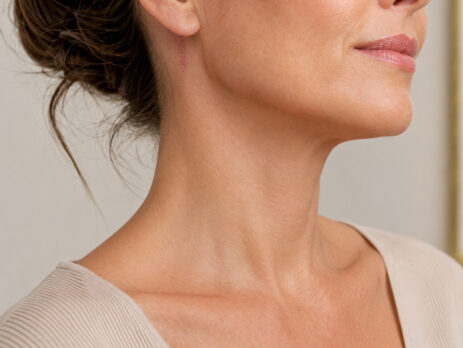
The area behind the ear is one of the anatomical regions that can provide an advantage in terms of scar concealment in neck lift surgery. The natural curve of the auricle and the transition behind the ear can help the healing incision line remain outside the direct field of view.
Especially when hair is worn down, the incision line behind the ear can be even more easily concealed in most cases. However, in individuals who wear their hair completely up or have very short hair, the redness during the early healing period may be more noticeable.
The appearance of the scar over time is not constant. There can be a significant difference between the appearance of an incision line in a newly operated patient and a scar that has completed 6-12 months. Therefore, the appearance a few weeks after the surgery should not be considered the permanent result.
How Does a Neck Lift Scar Look in the First Few Days?
After surgery, it is normal for the incision line to initially appear pink, red, or more prominent than the surrounding skin, which can be part of the usual wound healing process. Additionally, swelling, edema, and occasionally bruising may be observed in the surrounding area.
In the first few weeks, the wound line may feel harder. As healing continues beneath the skin, tension or tenderness may also occur around the incision line. Most of these symptoms decrease as healing progresses.
Scar maturation, however, is a much longer process than the resolution of edema. Therefore, it is not correct to answer the question “how many days do neck lift scars disappear?” solely in terms of days. Although the social recovery of the operated area may occur within a few weeks, the scar’s maturation in terms of color, thickness, and softness can take months.
When Does a Neck Lift Scar Fade?
Scar healing generally progresses gradually, although it varies from person to person. The incision line, which may be pinker or redder in the initial period, can gradually approximate the surrounding skin color over time.
Generally, the process can be considered as follows:
- First 1-2 weeks: The incision line is fresh and prominent. Edema, mild redness, and tenderness may be present.
- 2-6 weeks: While swelling decreases, the scar line may still appear pink or red.
- 2-3 months: The scar may gradually become calmer in appearance, but redness may persist in some individuals.
- 3-6 months: The color and firmness of the incision line may change significantly.
- 6-12 months: In many patients, the scar continues to mature, becoming thinner, flatter, and more similar in appearance to the surrounding skin.
- 12 months and beyond: Scar maturation may continue for a longer period in some individuals.
These timelines are not a definitive calendar. Each patient’s biological healing capacity is different. The process may progress differently, especially in individuals who have previously developed prominent surgical scars, hypertrophic scars, or keloids.
Is It Possible to Have No Scars After a Neck Lift?
It is not possible to biologically guarantee that no scar will form after a surgical procedure involving an incision in the skin. The healing of a surgical incision inevitably results in the formation of new tissue. The goal in plastic surgery is not to completely eliminate the scar; but to achieve a thin, flat, soft, as pale as possible, and anatomically concealable scar.
This distinction is important. Expressions like “scarless neck lift” used on the internet can sometimes create unrealistic expectations in patients. If the procedure is truly a surgical neck lift operation, an incision will be present. The important thing is the correct planning of the incision line and careful monitoring of wound healing.
What Affects the Prominence of a Neck Lift Scar?
The visibility of a scar after a neck lift operation is not solely determined by the surgeon’s incision placement. Wound healing is influenced by many different variables.
1. Individual’s Genetic Wound Healing Structure
While some people’s scars heal quite thin and pale, in others, the incision line can become thicker, red, or raised. How previous surgeries or injuries healed can provide important clues about the scar behavior of a new operation.
2. Tension on the Incision Line
One of the important factors regarding surgical scars is the mechanical tension on the wound line. In plastic surgery, a proper balance must be struck between removing excess tissue and not closing the wound with excessive tension.
Academic studies published on surgical scar prevention and management also emphasize that tension on the wound is one of the important modifiable factors affecting scar formation. You can access the academic evaluation on this topic via PubMed.
3. Smoking
Cigarettes and nicotine-containing products can negatively affect tissue blood supply and wound healing. Healthy blood supply to skin tissue is particularly important in neck and facelift surgeries.
For this reason, smoking must be reported to the physician during pre-operative assessment. Patient-specific planning regarding how long cigarettes or nicotine products should be quit must be done by the doctor.
4. Sun Exposure
Exposure of newly healed scars to intense sunlight can cause color changes to become more prominent. Protecting the incision line from the sun is especially important in the early post-operative period.
Therefore, physical protection from the sun and the use of appropriate sunscreen during the period recommended by your doctor can be part of scar care.
5. Infection and Wound Healing Problems
The development of infection in the surgical area, wound dehiscence, or delayed healing can increase the likelihood of a more prominent scar. Therefore, it is important not to miss post-operative check-ups and to contact the healthcare team if symptoms such as unusual redness, discharge, foul odor, increased pain, or fever occur.
6. Skin Structure and Age
Skin thickness, elasticity, color characteristics, and an individual’s biological wound healing capacity can affect the final appearance of the scar. Therefore, the scars of two individuals operated on with the same technique may not heal in exactly the same way.
7. Post-operative Care
Cleaning the incision line, proper dressing application, appropriate use of medications prescribed by the doctor, and regular attendance at check-ups help ensure healthy wound healing progression.
Cream, herbal products, oils, or different cosmetic products should not be applied to the wound without a doctor’s recommendation.
How to Care for Scars After Neck Lift?
There is no single standard product or method for scar care after a neck lift that can be applied to everyone. Different approaches may be used depending on how the wound closes, the individual’s skin characteristics, and the healing status.
In the postoperative period, the following applications may come into question based on the doctor’s assessment:
- Keeping the incision line clean and dry
- Applying dressings recommended by the doctor
- Sun protection
- Supporting the wound with silicone gel or silicone-based products at the appropriate time
- Using scar tapes when necessary
- Considering laser treatments for prominent scars
- Planning different medical treatments in case of hypertrophic scar or keloid development
Systematic studies examining the use of silicone-based products in postoperative scars report that positive effects on scar pigmentation, height, and elasticity may be observed in some patients. A systematic review and meta-analysis on this topic can be examined on PubMed.
Similarly, a systematic review published in 2023 evaluated randomized controlled trials investigating silicone gel-based products for postoperative scars. The research can be accessed via PubMed.
However, this information does not mean that any silicone product should be started on its own. The date on which the product should be started, whether the wound has completely closed, and the suitability of the product to be used should be evaluated by a doctor.
Should Scar Cream Be Used After Neck Lift?
“Which scar cream should be used after a neck lift?” is one of the frequently asked questions. However, it is not correct to use a random scar cream immediately after surgery.
First, the incision line needs to heal. Applying unsuitable products to an open or not yet fully healed wound can cause irritation or different problems. Once the wound has healed sufficiently, a doctor may recommend silicone gel, silicone tape, or a different scar care method.
A comprehensive systematic review published in 2025 on postoperative scar treatments shows that different options, from silicone products to laser methods, are used in the management of surgical scars and highlights the importance of personalizing treatment according to the characteristics of the scar. The study can be accessed via PubMed.
Does a Scar Remain Under the Chin in Neck Lift Surgery?
An incision under the chin is not mandatory in every neck lift surgery. However, in some surgical techniques, especially when direct intervention is required for laxity in the neck muscle called platysma, a limited incision under the chin may be used.
This incision is usually planned by utilizing the natural shadows and folds under the chin. Whether an incision is necessary is decided based on the individual’s neck anatomy and the procedures to be performed.
In academic surgical reviews published on neck rejuvenation techniques and incision options, periauricular, postauricular, hairline, and in necessary cases, submental (i.e., under-chin) approaches are discussed in detail. You can access the publication on this topic via the National Library of Medicine.
Are Neck Lift and Submental Liposuction the Same Thing?
No. Neck lift and submental liposuction are not the same procedure.
Submental liposuction is fundamentally a procedure aimed at reducing local fat tissue under the chin. It may be suitable on its own for individuals with sufficient skin elasticity and whose primary concern is localized fat accumulation.
A neck lift, on the other hand, can provide a more comprehensive surgical correction for individuals with significant skin laxity, neck sagging, or muscle relaxation in the neck.
In some patients, since both fat accumulation and skin laxity are present, a combined evaluation of both approaches may be necessary. Therefore, it is not appropriate to decide which procedure is needed by simply looking in a mirror.
Neck Lift or Jawline Filler?
Neck lift and jawline filler should also not be considered alternatives to each other.
Jawline filler can be used in suitable patients to enhance the definition of the jawline and support the proportions of the lower face. However, it does not eliminate severe skin excess.
If there is significant sagging, skin laxity, or muscle bands in the neck, adding volume alone may not be sufficient. In such cases, surgical options may need to be evaluated.
Can Neck Lift Be Performed Together with Facelift?
Yes. Facial and neck aging often do not progress completely independently. Looseness in the lower face area, an ill-defined jawline, and neck sagging can be seen together in the same person.
For this reason, planning facelift and neck lift procedures together in some patients can provide a more balanced face-neck transition.
However, this does not mean that every patient with problems only in the neck area needs a facelift. Facial aesthetics and neck aesthetics plans should be personalized according to the patient’s needs.
Can Raised Scars Form After a Neck Lift?
Rarely, a scar healing that is thicker or raised than normal may occur along the incision line. This condition may be associated with hypertrophic scarring or, in some individuals, a tendency for keloids.
It is important for individuals who have previously developed raised scars on the shoulder, chest, ear, abdomen, or other surgical areas to inform their doctor before surgery.
Early evaluation is important for prominent scars. Depending on the scar’s structure, silicone products, laser applications, or different medical methods can be considered. Information about Op. Dr. Şükrü İşler Aesthetic Clinic’s scar treatment options can also be obtained from the relevant page.
Can Laser Be Applied to Neck Lift Scars?
In suitable patients and once wound healing has reached an adequate level, laser applications can be considered for the purpose of improving the color, texture, or thickness characteristics of some surgical scars.
However, not every scar requires laser. A significant portion of newly formed scars mature spontaneously over time and become less noticeable. Therefore, the correct timing for laser treatment and whether it is truly necessary should be determined by a plastic surgery evaluation.
Does a Haircut Show the Scar After a Neck Lift?
In patients where the neck lift incision line extends into the hairy scalp area, very short haircuts may temporarily make the scar more easily noticeable. However, the incision line is not haphazardly placed just within the hair; the shape of the hairline and wound healing are also considered in surgical planning.
For women who frequently tie their hair up or men who wear short hair, it is beneficial to inform the surgeon about these habits when planning the incision.
Is a Neck Lift Scar More Noticeable in Men?
In men, due to the beard line, hair structure, sideburns, and the use of short hair, there may be specific details in incision planning. However, being male does not solely mean that the surgical scar will heal worse.
Personal skin structure, genetic wound healing, smoking, and surgical technique can be more important factors than gender.
What to Consider to Reduce the Risk of Scarring After a Neck Lift?
- Share your complete pre-operative health information with your doctor.
- If you have previously experienced poor or raised scar healing, be sure to mention it.
- Inform your doctor if you use cigarettes or nicotine.
- Follow the medication and dressing instructions given after the surgery.
- Do not pull or stretch the incision line unnecessarily.
- Do not start strenuous exercises without your doctor’s permission.
- Do not expose the newly healed scar to intense sun.
- Do not use cream or cosmetic products without a doctor’s recommendation.
- Do not miss your scheduled follow-up appointments.
- If you notice unusual redness, discharge, or opening along the incision line, consult your healthcare team.
When Do the Results Settle After a Neck Lift?
It is not correct to evaluate the result of a neck lift surgery solely by looking at the scar. In the first few weeks after the surgery, the neck contour may appear different than expected due to swelling.
It takes time for the swelling to subside, for the tissues to adapt to their new position, and for the incision lines to mature. Therefore, the final aesthetic appearance and the maturation of the scar do not happen on the same day.
During post-operative follow-ups, both the general contour of the neck and the development of scars are monitored. Additional recommendations for scar care may be planned if necessary.
Does Scarring After a Neck Lift Mean the Surgery Was Unsuccessful?
No. The presence of a fine incision scar in an area where surgery was performed does not mean the surgery was unsuccessful. In plastic surgery, the issue to be evaluated is not whether a scar exists, but rather its placement, width, color, elevation, and how noticeable it is.
In a well-planned neck lift surgery, the goal is to correct the neck contour while concealing the incision lines as much as possible within natural transitions.
Who Might Be Suitable for Neck Lift Surgery?
Neck lift can be considered especially for individuals who develop skin laxity in the neck as a result of aging, genetic factors, or significant weight changes.
Individuals with one or more of the following concerns may request an evaluation for neck aesthetics:
- Noticeable skin sagging in the neck
- Loss of jawline definition
- Significant laxity between the chin and neck
- Visible platysmal bands
- Neck appearing older despite the face looking young
- Excess skin on the neck after weight loss
- Loss of definition of the angle between the neck and jawline
However, not every sagging problem requires a neck lift. Localized fat deposits, a recessed jawline, skin quality, or changes in other areas of the face can create similar appearances. Physical examination is crucial for selecting the correct method.
What to Ask Your Doctor About Scars Before a Neck Lift?
In the pre-operative consultation, it is beneficial to discuss not only the aesthetic outcome but also incision and wound healing.
- Where will my incision line be?
- How much incision will there be behind the ear?
- Will the incision extend into the hairline?
- Is an incision under the chin necessary?
- Do my previous scars pose a risk?
- When will scar care begin?
- How long do I need to protect myself from the sun?
- Will I need to use silicone gel or tape?
- If laser treatment is needed, when can it be performed?
- Approximately how long can it take for the scar to fully mature?
Since the answers to these questions can vary from person to person, general information provided online does not replace a personal examination.
What Do Academic Studies Say About Neck Lifts and Scars?
In scientific publications examining neck rejuvenation surgery, incision designs extending from around the ear and behind the ear to the hairy scalp area are described for patients with excess skin. The length of the incision may vary according to the scope of the surgical correction required. One of the detailed surgical evaluations was published in the National Library of Medicine.
Academic literature examining surgical scar formation shows that incision design and mechanical tension along the wound line can play an important role in scar appearance. A comprehensive review on the subject is available via PubMed.
In systematic reviews regarding postoperative scar care, silicone-based products, laser applications, and various scar treatments have been investigated. A systematic review of postoperative scar treatments highlights the importance of personalizing treatment for surgical scars based on the characteristics of the scar.
A meta-analysis of randomized controlled trials on the use of silicone gel also reported improvement in some characteristics of postoperative scars. The relevant study is accessible via PubMed.
Are There Scars After Neck Lift? Short Answer
Yes, as neck lift is a surgical operation, a scar forms along the incision line; however, incision sites are typically planned by utilizing natural transitions around the ear, behind the ear, at the hairline, and in necessary cases, under the chin.
Scars that appear pink or red in the initial period may mature over time and become less noticeable. The final appearance of the scar depends on the individual’s wound healing characteristics and post-operative care, as well as the surgical technique used.
Therefore, when deciding on a neck lift, it would be a more realistic approach to focus on questions like “where will my incision line be, how will the scar be hidden, and how will my healing process be monitored?” instead of “will there be no scars at all?”.
First Examination or Consultation for Neck Lift is Free
If you are considering neck lift surgery due to neck sagging, a double chin appearance, or looseness in the jawline, it is first necessary to correctly identify the source of the existing problem.
At Op. Dr. Şükrü İşler Aesthetic Clinic, the first examination or consultation is free. During the consultation, your neck and jawline will be evaluated, and you can get information on whether a neck lift, facelift, submental liposuction, or a different approach is suitable for you.
At the same time, the estimated placement of the incision line, the risk of scarring, the post-operative healing process, and your personal wound healing characteristics can also be evaluated.
For detailed information and to request a consultation, you can use the online appointment form.
Frequently Asked Questions
Does neck lift surgery definitely leave a scar?
Biologically, a scar forms in every procedure involving a surgical incision. In neck lift surgery, the goal is not to completely eliminate the scar, but to ensure that the incision lines are hidden in natural anatomical areas and become as inconspicuous as possible over time.
Where will the neck lift scar be?
The incision is usually placed in the natural folds around and behind the ear and can be extended to the healthy skin border if necessary. In some techniques, a small incision under the chin may also be present.
How many months does it take for a neck lift scar to fade?
It is more accurate to speak of the scar maturing rather than completely “disappearing”. The scar, which may be pink or red in the initial months, usually continues to fade over several months. Final scar maturation can take 6-12 months or longer in some individuals.
Does a scar remain behind the ear after a neck lift?
If a surgical incision is made behind the ear, a scar will form there. However, the natural crease behind the ear can help keep the wound out of direct view.
Does a scar form under the chin after a neck lift?
Not in every patient. In some techniques that require direct intervention on the neck muscles or deep structures under the chin, a limited incision under the chin may be used.
Can a neck lift scar be covered with makeup?
Makeup should not be applied to the incision line until the wound has fully healed. After doctor’s approval, especially slight color differences remaining in the early period can be camouflaged with cosmetic products.
Can silicone gel be used after a neck lift?
Silicone-based scar products can be used in the care of some surgical scars. However, the wound must have closed sufficiently. The timing of use and product selection should be determined by the doctor.
Can a neck lift scar be treated with laser?
Laser treatments may be considered for suitable patients. However, not every scar requires laser treatment. If there is significant redness, thickening, or tissue difference in the scar, the appropriate treatment is chosen according to the scar’s characteristics.
Do neck lift scars whiten over time?
Many scars can change from their initial pinkish-red appearance to a lighter and paler color over time. The final color depends on the person’s skin tone and scar healing characteristics.
Does smoking affect the neck lift scar?
Smoking and nicotine are significant risk factors in face and neck lift surgeries because they can negatively affect tissue circulation and wound healing. Smoking habits must be reported to the doctor before the surgery.
Can I have a neck lift if my old surgical scars are problematic?
Having previously developed hypertrophic scars or keloids does not automatically mean that surgery cannot be performed, but it is important risk information. Previous scars should be evaluated during the examination, and a personal risk analysis should be performed.
If a neck lift and face lift are performed together, will the scarring increase?
In combined surgeries, the incision plan may expand according to the procedures to be performed. However, it may be possible to arrange the tissues of the face and neck in a balanced manner within the same surgical plan. The length and placement of the incision are determined individually.
If I have submental liposuction instead of a neck lift, will there be no scar?
Submental liposuction can be performed with much smaller entry points, but it does not treat the same problem as a neck lift. In individuals with significant skin sagging, only removing fat may not provide the desired result.
Can neck lift surgery scars be completely erased?
In no scar treatment can it be guaranteed that the scar will be completely eliminated. The purpose of scar treatments applied when necessary is to improve the color, thickness, or texture of the scar, making it less noticeable.
Can I get information about scars during a free consultation for a neck lift?
Yes. At Op. Dr. Şükrü İşler Aesthetic Clinic, the first examination or consultation is free of charge. A personal evaluation can be made regarding your neck structure, excess skin, planned surgical method, incision sites, and the post-operative scar process.
Important Information
This content has been prepared for general informational purposes regarding neck lift surgery, incision scars, and wound healing. Each patient’s anatomy, skin characteristics, wound healing capacity, and the surgical method to be applied are different. The information provided here does not substitute for a personal examination, diagnosis, or treatment recommendation. The appropriate surgical method and post-operative care plan for you should be determined as a result of an evaluation by a plastic surgery specialist.