

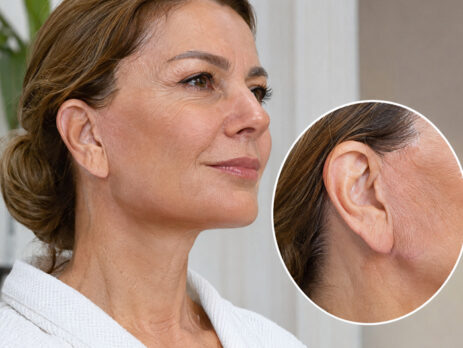
Why Does the Earlobe Change After a Facelift?
Why Does the Earlobe Change After a Facelift?
The downward elongation of the earlobe, its adherence to the cheek, or a noticeable difference between the two ears after a facelift surgery are some aesthetic issues that some patients may encounter. This change is not always permanent; early swelling and tissue tension can affect the appearance. However, if the earlobe loses its natural curve and is pulled downwards, it may indicate a condition known in medicine as pixie ear deformity. To determine the cause and the appropriate approach, the tissues around the ear should be evaluated along with the time elapsed since the surgery.
What is Pixie Ear Deformity?
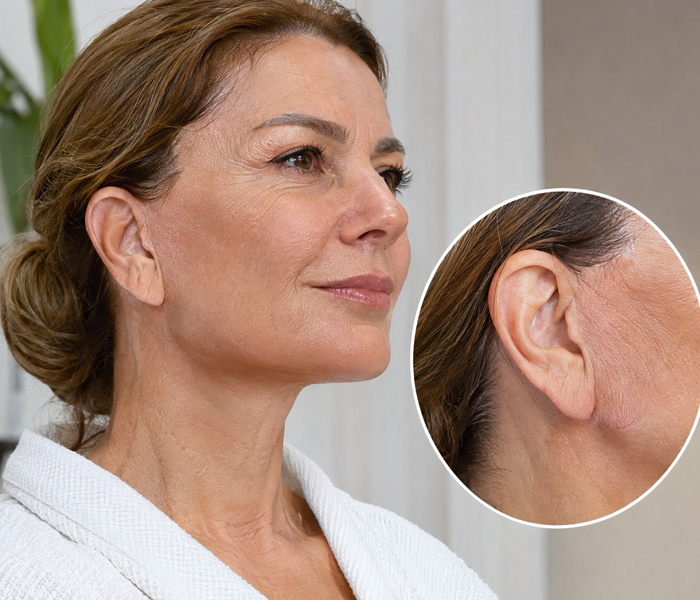
Normally, there is a soft, natural transition between the earlobe and the cheek. When a pixie ear forms, this transition blurs; the earlobe may appear pulled downwards and forwards, elongated, or fixed to the skin. It is particularly noticeable in profile photos. A long earlobe alone does not indicate the presence of this deformity. What is important is the change from the pre-surgery shape and the relationship of the earlobe to the face.
This appearance is different from a prominent ear problem or a congenital earlobe structure. Deciding solely based on the size of the earlobe can be misleading. When comparing with previous photos, the position of the lower edge of the earlobe, the angle at which it joins the cheek, and the symmetry of the two ears are examined together. The loss of the natural space between the earlobe and the cheek is particularly an important clue.
Why Does the Earlobe Get Pulled Downwards?
The most important mechanism is the transmission of tensile force from healing tissues to the earlobe. During a facelift, the skin is repositioned, and excess skin may be removed. The position of the earlobe can be affected if the natural connections around the ear are not sufficiently preserved or if excessive tension is created along the closure line.
- Excessive skin tension: Excessive pulling or removal of skin can pull the earlobe downwards.
- Positioning of supporting tissues: Tension on the SMAS, the deep supporting layer of the face, can radiate around the ear if not distributed properly.
- Scar tissue contraction: The scar that develops as the wound heals can reduce the natural mobility of the earlobe.
- Suture and incision plan: The method of fixation at the base of the earlobe can affect the final appearance.
Clinical research published in the Aesthetic Surgery Journal explains the role of the amount of skin removed, tension vectors, and SMAS-related traction forces in earlobe deformation.
Is Every Shape Change Permanent?
No. In the first weeks after surgery, temporary asymmetry due to edema, bruising, and the healing process may be observed. As the tissues around the face and ear settle, the appearance may change. However, it should not be assumed that a true retraction deformity will completely resolve simply by waiting. If there is significant earlobe elongation, adherence to the cheek, or progressively increasing asymmetry, the surgeon who performed the operation should evaluate it.
General facial contour settling after facelift surgery can take months. When evaluating the condition of the earlobe, pre- and post-operative photos taken in the same light can be more useful than just daily changes seen in the mirror.
During the healing process, it is also possible to feel occasional hardness or slight tension around the ear. This sensation alone does not prove a permanent deformity. Following photos from a similar angle for weeks can be helpful; however, it does not replace regular surgical check-ups for personal evaluation. It is not recommended to try to test the appearance by manually pulling the earlobe downwards.
Which Symptoms Require Consulting a Doctor?
The lengthening of the earlobe downwards, the loss of the natural notch between it and the cheek, or the formation of different shapes on both sides should be shared during a follow-up examination. Suddenly increased unilateral swelling, severe pain, active bleeding, foul-smelling discharge, fever, or significant darkening of the skin, independently of the aesthetic outcome, requires immediate medical evaluation. These symptoms cannot be explained solely by pixie ear.
Individuals experiencing reduced sensation around the ear can also review the information regarding numbness after facelift.
How Is Deformity Corrected?
Treatment varies depending on the degree of the deformity and the underlying cause. For mild, early-stage appearance differences, observation may be sufficient. In cases of permanent pulling, surgical correction options aimed at freeing the earlobe, reshaping the attachment point, or reducing tension in the surrounding tissues are evaluated. While a limited intervention may be possible in some patients, others may require a more extensive revision.
A 2024 literature review compares different techniques for the prevention and correction of pixie ear deformity. Additionally, a clinical study published in 2026 reported that partial rotation of the earlobe might be an option in selected patients. These findings do not mean that the same procedure should be applied to every patient.
The aim of the procedure is not merely to move the earlobe higher, but to recreate its natural connection with the face. The surgeon considers the previous location of the scar and the skin mobility in the area. As the extent of the correction increases, the healing process and any new scars that may form can also change. Therefore, establishing a realistic expectation of the outcome before surgery is particularly important.
How Long Should One Wait for Revision Surgery?
The exact timing is individual. It is advisable to wait for the early-stage swelling to subside, tissues to soften, and the surgical scar to mature. However, if there is severe retraction or a wound healing issue, delaying the check-up is not advisable. When deciding on a revision, the previous surgical technique, skin condition, scar location, and the patient’s expectations are all considered. The content we prepared about scars after neck lift can also help in understanding wound healing around the ear.
How to Reduce Risk in Surgical Planning?
In preserving the natural appearance of the earlobe, not only the tension of the skin, but also the correct positioning of supporting tissues and the planning of the incision line are important. An academic study examining revision facelift cases addresses the potential benefit of techniques for earlobe fixation and managing tension directions. No method guarantees zero risk; an individual’s anatomy and previous surgeries may affect the outcome.
Post-Facelift Evaluation in Bursa
At Op. Dr. Şükrü İşler Aesthetic Clinic, changes in shape around the face and ears can be evaluated within the framework of personal anatomy, recovery period, and expectations. The first examination or initial consultation at our clinic is free. During the examination, it can be discussed whether the deformity might be related to temporary tissue changes or permanent pulling. To get information and schedule a consultation, you can use our online appointment page.
Frequently Asked Questions
Is earlobe elongation after facelift normal?
In the initial period, there may be temporary shape differences. However, a noticeable downward pulling of the earlobe should not always be considered normal healing.
Does pixie ear go away on its own?
Swelling-induced appearance may improve. In permanent deformities caused by actual tissue retraction and scarring, surgical evaluation may be necessary.
Does earlobe correction leave a scar?
Surgical incisions can create scars. The visibility of the scar depends on the incision site, skin characteristics, and healing; a completely scarless outcome cannot be guaranteed.
Can deformity occur in one ear?
Yes. When skin tension, healing, and anatomical features differ on both sides, one side may be more significantly affected.
Can an earlobe be corrected with massage at home?
Do not apply massage or pulling unless recommended by your surgeon. Especially in the early period, these interventions can irritate the incision line.
Does this problem require a revision facelift?
Not always. In some cases, limited corrections may be sufficient; the appropriate approach can only be determined after an examination.
This content is for general informational purposes only; it does not substitute for personal diagnosis and treatment recommendations.