How to Shape a Flat Buttocks? BBL or Buttock Implant?
How to Shape Flat Buttocks? BBL or Butt Implants?
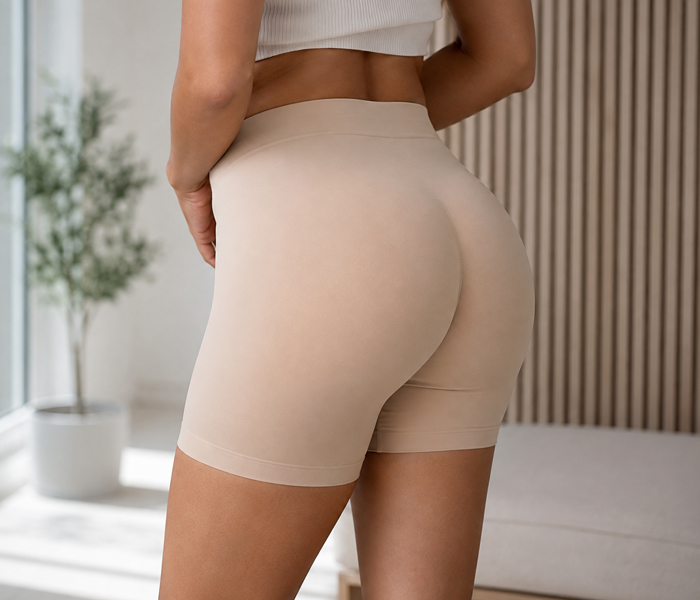
A flat buttock appearance can result from genetic body structure, the volume of gluteal muscles, fat tissue distribution, pelvic structure, weight changes, and age-related tissue alterations. Insufficient buttock projection, especially from a side profile, a hollow appearance in the upper section, or the absence of a distinct curve between the waist and hips can create a ‘flat butt’ look in an individual.
The two most commonly considered options for shaping flat buttocks with aesthetic surgery are BBL (Brazilian Butt Lift – buttock fat injection) and butt implants (gluteal implants). However, there isn’t a single answer to the question ‘Is BBL better, or butt implants?’ that applies to everyone.
The short answer can be summarized as follows: BBL can be considered for individuals who have sufficient fat tissue in their body and wish to shape the contour of their waist, back, hips, or abdomen along with their buttocks. For very thin individuals who do not have enough suitable fat for transfer in their body, butt implants can be a significant alternative.
However, the appropriate method is not determined solely by a person’s weight. The existing shape of the buttocks, skin quality, muscle structure, desired volume, current fat distribution, hip width, waist-hip ratio, expectations, and the person’s general health status should all be evaluated together.
At Op. Dr. Şükrü İşler Aesthetic Clinic, the first examination or consultation is free of charge. You can learn what anatomical features cause your flat buttock appearance and whether BBL, buttock implants, or a different body contouring method can be evaluated for you during the free initial consultation.
What Does a Flat Buttock Mean?
“Flat buttock” is not a medical condition or diagnosis on its own. It is an aesthetic term typically used to describe a situation where the buttock’s posterior projection is limited, upper buttock fullness is low, the hip-waist transition does not appear sufficiently defined, or the buttock appears volumeless within overall body proportions.
A flat buttock appearance can arise from different reasons in different people. While the primary problem in one person might be a lack of upper buttock volume, another person might have depressions in the lateral parts of the buttocks. In some individuals, fat distribution around the waist and hips, rather than the buttocks themselves, can cause the buttocks to appear flatter than they are.
Therefore, when evaluating a flat buttock, it is not sufficient to look solely at the buttocks. The waist, back, hips, outer thighs, and buttocks should be evaluated together.
Those who wish to examine the general scope of buttock shaping methods can also review the Buttock Aesthetics – Gluteal Aesthetics page.
Why Do Buttocks Appear Flat?
There is no single cause for a flat buttock appearance. The most common factors are:
- Having genetically low buttock volume,
- Less fat tissue in the hip area,
- Lack of volume in the gluteal muscle structure,
- The waist area not appearing sufficiently slender,
- Emptiness in the upper part of the hips,
- Presence of noticeable indentations in the side hip areas,
- Pelvis and skeletal structure,
- Significant weight loss,
- Changes in fat distribution and skin elasticity with age,
- Development of sagging or soft tissue laxity in the hips.
Genetic fat distribution, in particular, can play a significant role in hip appearance. Although two individuals may be of the same weight and similar height, one’s hips may appear rounder, while the other’s may appear flatter.
For more detailed information on the effect of genetic and anatomical characteristics on aesthetic results, the content Does Genetic Structure Change Aesthetic Outcomes? can also be reviewed.
Can Exercise Fix Flat Hips?
Exercises targeting the hip muscles can help develop the gluteus maximus, gluteus medius, and surrounding muscle groups. Resistance exercises such as squats, hip thrusts, lunges, and similar movements can increase muscle volume when performed regularly.
However, the effect of exercise depends on an individual’s genetic makeup, muscle development capacity, nutrition, and current body composition.
Exercise:
- Can develop hip muscles,
- Can contribute to a firmer appearance of the hips,
- Can improve body composition,
- Can change the appearance of the waist-to-hip ratio.
However, exercise cannot completely redesign fat distribution in the hips, cannot change the skeletal structure that forms hip width, and does not provide an exact equivalent to the volume increase achievable through surgical methods.
Therefore, insufficient hip projection despite regular exercise can be a completely normal anatomical feature in some individuals.
What Methods Are Used in Flat Buttock Aesthetics?
The method that can be applied in flat buttock shaping varies according to the individual’s problem. The most frequently considered options are:
- BBL – fat injection to the buttocks,
- Buttock prosthesis – gluteal implant,
- Shaping of the waist and surrounding areas with liposuction,
- Buttock lift operations,
- Planning multiple methods together in selected cases.
For example, a person who actually has sufficient buttock volume but has excessive fat accumulation in the waist and back area may have buttocks that appear flatter than they are. In this case, instead of adding too much volume to the buttocks, regulating the contour of the surrounding areas can provide a more balanced appearance.
In contrast, a different approach may be required for a very slender person with an already thin waist and quite low hip projection.
What is BBL?
BBL, or Brazilian Butt Lift, is a body shaping operation where fat tissue taken from the person’s own body is transferred to the buttock area after undergoing certain procedures.
Typically, fat located in the abdomen, waist, back, thighs, or other suitable areas is removed using liposuction. The obtained fat tissue is prepared and transferred to specific areas of the buttocks in accordance with the surgical plan.
One of the important features of BBL is that it does not only aim to increase the volume of the buttocks. By also shaping the areas from which fat is taken, the goal may be to make the waist-hip transition more pronounced.
For this reason, BBL is often considered a comprehensive body contouring procedure rather than a “buttock augmentation surgery”.
For details of the procedure, you can review the guide What is Brazilian Butt Lift (BBL)? Natural-Looking Buttock Aesthetics.
How Does BBL Shape Flat Buttocks?
In BBL planning, the aim is not to add the same amount of fat to every part of the buttocks. Volume deficiencies in the upper, middle, or lateral sections of the buttocks are evaluated according to the individual’s anatomy.
At the same time, liposuction procedures performed on the waist, back, and hip areas can make the contour around the buttocks more defined.
For example, in a person whose buttocks appear lacking in volume but has sufficient fat tissue in the waist and hip area:
- The waistline can be thinned,
- The back contour can be sculpted,
- The hip transitions can be shaped,
- Suitable fat tissue obtained can be transferred to the buttocks,
- The waist-hip ratio can be rebalanced.
Therefore, the result of BBL is not solely dependent on the amount of fat injected. Where the fat is taken from and how the body contour is designed are also important.
What Are the Advantages of BBL?
In the appropriate patient group, the prominent features of BBL are:
- The person’s own fat tissue is used.
- Along with the buttock volume, the waist and surrounding areas can be shaped.
- The natural softness of the buttock tissue can be preserved.
- Customized contour can be given to different regions of the buttocks.
- Unwanted localized fat deposits in the body can be addressed within the same surgical plan.
- It may be possible to emphasize the waist-hip transition.
However, the existence of BBL’s advantages does not mean that the procedure is suitable for everyone.
What Are the Disadvantages and Limitations of BBL?
One of the significant limitations of BBL is the need for sufficient donor fat tissue.
In very thin individuals, there may not be enough fat available to harvest from the abdomen, waist, back, and thighs. Furthermore, not all of the transferred fat survives permanently. A portion of the fat may be reabsorbed by the body during the healing period.
The final volume, therefore, may not be exactly the same as the initial appearance immediately after surgery.
BBL is also a surgical procedure that requires adherence to strict safety rules. One of the most significant controversies in gluteal fat injection is the risk of fat embolism. In the current safety approach, it is particularly important not to inject fat into the gluteal muscle and to perform the injection in a safe anatomical plane.
In the joint safety statement of the American Society of Plastic Surgeons (ASPS), The Aesthetic Society, and relevant professional organizations, it is stated that real-time ultrasound imaging can help monitor the anatomical position of the injection cannula. The ASPS Gluteal Fat Grafting Safety Statement on this matter can be reviewed.
A systematic review and meta-analysis published in the journal Plastic and Reconstructive Surgery in 2026, covering more than 22,000 patients, reported results supporting the importance of subcutaneous injection and ultrasound guidance for safety. For the academic study, the link PubMed: Gluteal Augmentation with Fat Grafting – Systematic Review and Meta-Analysis can be reviewed.
These data do not mean that BBL is risk-free. As with any surgical procedure, there is a risk of complications, and a personal risk assessment should be performed before surgery.
What is a Buttock Implant?
Buttock implant, or gluteal implant, is a surgical procedure where specially designed implants are surgically placed in the gluteal region to add volume and projection to the buttocks.
It does not have the same purpose or placement method as breast implants. The characteristics, size, and surgical placement plan of the implant to be used are determined according to the anatomy of the buttocks.
A buttock implant is an important option, especially for individuals who are too thin to have a sufficient amount of fat transferred to their buttocks.
How Do Buttock Implants Shape Flat Buttocks?
A gluteal implant can be used specifically to increase the posterior projection of the buttocks.
While in BBL, volume is related to the individual’s existing fat amount, in the implant method, there is no need for sufficient fat reserves in another part of the body for volume.
Therefore:
- Individuals with a very low body fat percentage,
- Individuals for whom sufficient donor fat cannot be obtained with liposuction,
- Selected individuals with a significant need for volume in the central and posterior projection of the buttocks
the implant method can be considered.
What Are the Advantages of Buttock Implants?
Among the main advantages of a buttock implant are:
- No need for donor fat tissue,
- Ability to create significant volume even in very thin individuals,
- Absence of a situation where transferred fat is partially reabsorbed over time,
- Ability to increase hip projection according to the surgical plan.
However, implant surgery also has its own surgical risks and recovery characteristics.
What are the Disadvantages and Risks of Buttock Implants?
Possible complications to be considered in gluteal implant surgery include:
- Wound healing problems,
- Seroma,
- Infection,
- Palpability of the implant,
- Implant displacement or position problem,
- Asymmetry,
- Capsular contracture,
- Rarely, situations requiring implant removal
may occur.
A systematic review and meta-analysis published in 2025 in Plastic and Reconstructive Surgery journal, covering 32 studies and 2,682 patients, indicates that implant placement technique may have a significant impact on the complication profile. The research can be accessed via the link PubMed: Complications Following Primary Implant-Based Gluteal Augmentation.
Therefore, in buttock augmentation, not only the size of the implant but also the patient’s anatomy and the surgical approach used are important.
BBL or Buttock Implant? Key Differences
| Feature | BBL / Fat Injection | Buttock Implant |
|---|---|---|
| Material used | Patient’s own fat tissue | Gluteal implant |
| Is donor fat required? | Yes | No |
| Applicability in very thin individuals | Fat volume may be insufficient | Can be an important alternative in selected individuals |
| Waist contouring | Can be performed within the same plan thanks to liposuction | Prosthesis alone does not slim the waist area |
| Feel of the buttock tissue | It is the individual’s own fat tissue | Implant is present |
| Volume permanence | A portion of the fat may be absorbed, living fat cells can remain for a long time | Provides volume as long as the implant is not removed or replaced |
| Important risk categories | Fat transfer-specific risks including fat embolism, infection, seroma, contour irregularities | Wound problems, seroma, infection, implant position, palpability, capsular contracture |
How Are BBL and Buttock Implants Compared in Scientific Studies?
When comparing BBL and gluteal implants, it should be noted that different studies involve different patient groups, surgical techniques, and follow-up periods. Therefore, directly applying a single complication percentage to every patient is not accurate.
A systematic review published in the Journal of Plastic, Reconstructive & Aesthetic Surgery in 2023 compared autologous fat transfer with gluteal implants. While the study reported that overall complication rates were lower in the fat transfer group than in the implant group, it was specifically emphasized that gluteal fat injection could lead to serious complications if safety guidelines are not followed.
The full study can be accessed at the link: PubMed: Comparing the Safety Profiles of Implants and Autologous Fat Grafting in Gluteal Augmentation.
Newer studies particularly focus on the injection plane and the use of ultrasound in BBL; while in implant surgery, they focus on the anatomical plane where the implant is placed and the implant characteristics.
Therefore, before asking “which method has a lower complication rate?”, it is more meaningful to ask “which method is suitable for my anatomy and with what safety principles will this method be applied?”
Can BBL Be Performed on Very Thin Individuals?
For BBL to be performed, there must be a sufficient amount of suitable fat tissue in the person’s body that can be safely removed with liposuction.
If a very thin person does not have enough fat tissue in their waist, abdomen, back, and thigh areas, the amount of fat that can be transferred to the buttocks may be limited.
In this case, removing more fat than necessary solely for the purpose of achieving the desired look is not the right approach.
In individuals where donor fat is insufficient, alternatives such as gluteal implants can be considered. However, the decision is not made solely by looking at the person’s weight or body mass index.
Is It Necessary to Gain Weight for BBL?
Gaining weight uncontrollably solely for the purpose of getting BBL is generally not a good strategy.
Rapid weight gain and loss can negatively affect body contour and skin elasticity. Furthermore, losing weight again after the surgery can alter the volume of transferred fat cells and body proportions.
Therefore, it is a healthier approach to make an assessment based on your current body structure and to discuss alternative methods if necessary.
Does a Buttock Implant Give More Volume Than BBL?
Not always.
The volume that can be achieved depends on personalized planning. While a significant increase in volume can be achieved with BBL in individuals with sufficient donor fat, the amount of fat that can be transferred is limited in very thin individuals.
Implants have a specific and predictable physical volume; however, it is not correct to choose an implant based solely on the “biggest implant” logic.
Implant size and shape should be determined according to hip width, muscle thickness, soft tissue coverage, and body proportions.
Does BBL Look More Natural?
Since a person’s own fat tissue is used in BBL, natural transitions can be created with the right patient and proper planning.
However, there is no definitive rule that “BBL always looks natural”. Naturalness largely depends on:
- The amount of volume given,
- The distribution of fat,
- The waist-to-hip ratio,
- The individual’s skeletal structure,
- The existing buttock anatomy,
- Surgical planning
depends.
Similarly, with implants placed in the appropriate size and correct anatomical plane, the goal is to create a buttock contour that is harmonious with the person’s body.
If There Are Hip Dips, Is BBL or a Prosthesis More Suitable?
Lateral hip depressions, known as hip dips, are largely related to pelvic anatomy, muscle structure, and fat distribution.
BBL can provide an advantage in terms of regional contouring in suitable individuals, as fat can be transferred not only to the center but also to the lateral contours of the buttocks.
The primary effect of a gluteal implant, depending on the shape and position of the implant used, is on buttock projection.
However, hip dips are not an anatomical defect that needs to be completely eliminated and are a normal part of the natural body structure in many people. The goal is to plan a proportionate appearance suitable for the individual.
What to Do if There is Sagging Along with Flat Buttocks?
Lack of volume and true skin sagging are not the same problem.
Especially in individuals who have experienced significant weight loss, the buttocks may appear flat while also having downward sagging of skin and soft tissue.
In such cases, merely adding volume to the buttocks may not be sufficient. Buttock lift operations, where excess skin needs to be removed or tissues repositioned, may become relevant.
For detailed information on this topic, the content Does Buttock Aesthetics Correct Sagging? can be reviewed.
If there is deformation in more than one area after significant weight loss, the guide Body Contouring Sequence After Weight Loss may also be helpful.
Can Liposuction Alone Make Flat Buttocks Appear More Shaped?
In some individuals, yes.
Even if the buttocks have sufficient volume, excess fat in the waist, back, or hip area can obscure the buttock contour.
In this situation, contouring the surrounding tissues with liposuction can make the waist-to-hip ratio more prominent, even if no volume is added to the buttocks.
However, in an individual whose buttocks genuinely lack volume, liposuction alone does not create volume.
To understand the differences between liposuction and skin-removing operations, the content Tummy Tuck or Liposuction? can be reviewed.
Does Fat Melt After BBL?
It is not expected that all of the transferred fat will be permanent.
In the initial period after the surgery, a portion of the fat may be absorbed by the body. However, fat cells that establish a blood supply and survive in the new area behave like other fat cells in the body.
Therefore, significant weight gain or loss in the long term can also affect buttock volume.
For the result to be evaluated, the swelling must decrease, and the transferred fat tissue must stabilize.
Do Buttock Implants Last a Lifetime?
It is not correct to consider buttock implants as ‘once placed, they require no checks for life’.
Implants can provide volume long-term, but clinical follow-up may be necessary throughout the person’s life. Revision or implant replacement may be necessary in subsequent years due to infection, changes in implant position, capsular contracture, or various other clinical reasons.
Therefore, during the pre-operative consultation, not only the early recovery period but also long-term follow-up should be discussed.
Can BBL and Buttock Implants Be Done at the Same Time?
In some selected cases, combination methods may be considered. However, applying both methods together is not necessary or suitable for every patient.
Combining surgical procedures can change the operation time, recovery period, and risk profile.
Therefore, the approach of ‘more procedures yield better results’ is incorrect. The goal is not to perform as many procedures as possible, but to create the most suitable surgical plan that adequately addresses the individual’s anatomical problem.
Is the Recovery Process After BBL and Buttock Implants the Same?
No.
Since the surgical techniques for the two operations are different, their recovery processes are also different.
After BBL, both the areas where liposuction was performed and the buttocks where fat was transferred need to heal. In buttock implants, the healing of the surgical area where the implant is placed and the implant becoming compatible with the surrounding tissues are important.
The protocol to be followed regarding sitting, sleeping position, returning to daily activities, corset use, and returning to exercise may vary according to the performed operation and the surgeon’s plan.
Adhering to the personal instructions given after surgery is an important part of the recovery process.
Which is the Best Method for Flat Buttocks?
There is no single “best” method.
The most appropriate method is the one suitable for the individual’s anatomical problem.
For example:
If there is sufficient fat tissue + a need for shaping around the waist: BBL may be considered.
If there is a very thin body structure + insufficient donor fat: Buttock implants may be considered.
If there is significant skin sagging: Buttock lift methods may be required.
If buttock volume is sufficient but the waist circumference is thick: Contour reshaping with liposuction may be sufficient.
If more than one problem exists simultaneously: Combined or staged surgical planning may be on the agenda.
This distinction cannot be definitively made by merely looking at a photo online.
What is Evaluated for BBL and Buttock Implants in the Free Initial Consultation?
The initial examination or consultation at Op. Dr. Şükrü İşler Aesthetic Clinic is free of charge.
During the free initial consultation, while your flat buttock complaint is being evaluated, generally:
- The current width and projection of the buttocks,
- Upper and lower buttock fullness,
- Waist-hip ratio,
- Hip dips,
- Elasticity of the hip skin,
- Presence of sagging,
- Fat distribution in the abdomen, waist, back, and thighs,
- Availability of sufficient donor fat for BBL,
- Muscle and soft tissue structure,
- Expected volume amount,
- Previous operations,
- Your general health condition,
- Medications you are using,
- Smoking and nicotine use,
- Your expectations
can be evaluated.
Then, it can be discussed whether BBL, buttock implant, liposuction, buttock lift, or a different approach can be considered.
If you are considering aesthetic surgery for the first time, you can also read the content of the Beginner’s Guide for Those Having Aesthetic Surgery for the First Time.
Frequently Asked Questions
Can a flat buttock become completely round with BBL?
The change that can be achieved depends on the individual’s initial anatomy, existing fat amount, hip width, skin structure, and surgical planning. Copying another person’s buttock appearance exactly is not a realistic goal.
Is BBL or buttock implant more permanent?
The permanence mechanisms of the two methods are different. In BBL, fat cells that continue to live in the new area can remain for a long time but may be affected by weight changes. The implant continues to provide physical volume, but situations that may require control, revision, or replacement may develop in later years.
Can BBL be performed on a very thin person?
If there is not enough donor fat tissue, the volume that can be achieved with BBL may be limited. In such cases, alternatives like buttock implants can be considered.
How much should one weigh for BBL?
There isn’t a single ideal weight or body mass index for BBL. What matters is the person’s overall health status and the availability of sufficient donor fat tissue that can be safely harvested.
Is it advisable to gain weight for BBL?
Uncontrolled weight gain solely for the purpose of the operation is not a recommended standard approach. Evaluating the existing body structure is more appropriate.
Are buttock implants noticeable from the outside?
The palpability and visibility of the implant depend on factors such as the person’s soft tissue thickness, the size, shape, and placement plan of the implant. Especially in very thin individuals, evaluating the soft tissue coverage is important.
Is there a risk of fat embolism in BBL?
Yes. Fat embolism is one of the most serious complications of gluteal fat injection. Current safety approaches emphasize performing the injection in the subcutaneous plane above the muscle and highlight safety methods for controlling the anatomical plane. The risk can never be entirely eliminated in any surgical procedure.
Is BBL surgery safe?
BBL is a serious surgical operation. Patient selection, surgical technique, injection plane, application environment, and post-operative follow-up are important for safety. Personal risk can only be determined through a physician’s assessment.
Are buttock implants risky?
Like any implant surgery, gluteal implant surgery also carries potential complications such as infection, wound healing problems, seroma, implant malposition, and capsular contracture.
Does a buttock implant or BBL feel more natural?
In BBL, the person’s own fat tissue is used. In an implant operation, an implant is placed in the buttock. However, the result and sensation depend not only on the material used but also on the soft tissue thickness and surgical planning.
Does BBL lift the buttock?
Increasing the volume of the upper buttock and shaping the waist area can make the buttock appear more lifted in some individuals. However, if there is actual and severe skin laxity, fat injection alone may not be sufficient.
Is silicone or fat injection better for flat buttocks?
While fat injection may offer an advantage in individuals with sufficient fat tissue, an implant might be a more suitable alternative for very thin individuals. Which method is better varies from person to person.
Can fat injection be performed again after BBL?
In some individuals, after healing is complete and the result is evaluated, the need for additional volume may arise. However, the necessity and timing of a second operation should be determined by a physician’s assessment.
Can a buttock implant be removed?
Yes. If clinically necessary, a gluteal implant can be surgically removed or replaced. However, the buttock shape after removal may not be exactly the same as the initial state.
Do scars remain after buttock aesthetics?
In procedures involving surgical incisions, a completely scarless recovery cannot be guaranteed. The location and visibility of scars depend on the method applied, the individual’s wound healing characteristics, and the post-operative process.
Are BBL and liposuction the same thing?
No. Liposuction is the process of removing localized fat tissue and shaping the body contour. In BBL, suitable fat tissue removed by liposuction is prepared and transferred to the buttocks.
Is the first consultation for flat buttock aesthetics free?
No. At Op. Dr. Şükrü İşler Aesthetic Clinic, the first examination or consultation is free. Your buttock’s anatomical structure, your expectations, and methods that can be evaluated can be discussed during the free initial consultation.
BBL or Buttock Implant?
Although BBL and buttock implants might seem like direct alternatives for shaping flat buttocks, they are actually methods that address different anatomical needs.
BBL can provide volume to the buttocks in individuals with sufficient donor fat, while also allowing for the shaping of the waist, back, abdomen, or hip areas. Therefore, it can be an important option, especially for individuals who wish to change their body contour as a whole.
Buttock implants, on the other hand, can be considered for individuals with a lean physique who do not have sufficient fat tissue for fat transfer, to increase buttock projection.
However, if the person’s problem is not just a lack of volume but actual skin sagging, BBL or implants alone may not be sufficient, and different surgical methods like buttock lift might be required.
Scientific studies also do not show that a single method is superior for all patients. Current literature emphasizes the importance of performing injections in a safe anatomical plane and using safety methods like real-time ultrasound when necessary in BBL, and the importance of correct patient selection and appropriate implant placement technique in implant surgery.
Therefore, the correct question is not merely “BBL or implant?”. The real question should be “Which method is more suitable for my hip anatomy, fat distribution, skin structure, and the appearance I aim for?”
The initial examination or consultation at Op. Dr. Şükrü İşler Aesthetic Clinic is free. You can benefit from a free initial consultation to evaluate the reason for your flat hip appearance, find out if you have enough fat tissue for BBL, discuss whether buttock implants are suitable for you, and get information about the options that can be applied according to your personal body proportions.
For appointment and consultation information, you can use the Op. Dr. Şükrü İşler Aesthetic Clinic Contact page.
Important Information: This content has been prepared for general informational purposes and does not substitute for personal diagnosis or treatment recommendations. The suitability, risks, and expected results of BBL, gluteal implants, and other body contouring operations vary from person to person. The definitive surgical plan should be created after examination by a Plastic, Reconstructive, and Aesthetic Surgery specialist and necessary medical evaluations.