Can Glasses Be Worn After Prominent Ear Surgery?
Can Glasses Be Worn After Prominent Ear Surgery?
The question of whether glasses can be worn after prominent ear surgery is one of the most frequently asked questions before otoplasty, especially by individuals who constantly wear prescription glasses. The short answer is: There is no complete and permanent obstacle to wearing glasses after prominent ear surgery; however, caution should be exercised regarding the pressure exerted by the spectacle frames on the ear, particularly on the surgical area behind the ear, during the early recovery period of the surgery.
When glasses can be used normally is not the same for everyone. The surgical technique used, the location of the incision line behind the ear, the reshaping procedures applied to the cartilage, the sutures used, the amount of swelling, wound healing, and the structure of the patient’s glasses can affect this period.
Therefore, it is not appropriate to talk about definitive periods that apply to everyone, such as “glasses can be worn exactly 7 days after surgery” or “glasses absolutely cannot be used for a month,” as seen on the internet. The timing of glasses use after otoplasty should be determined by the plastic surgeon who performed the surgery, based on the individual’s recovery status.
At Op. Dr. Şükrü İşler Aesthetic Clinic, the first examination or first consultation is free of charge. Individuals who constantly wear glasses can receive a personal evaluation regarding how they can use their glasses in the post-operative period by bringing their glasses frames with them during the operation planning.
For more detailed information about the general characteristics and recovery process of prominent ear surgery, you can review the pages What is Prominent Ear Aesthetics (Otoplasty)? and Ear Aesthetics.
Why Are Glasses Important After Prominent Ear Surgery?
In prominent ear aesthetics, the aim is not merely to set the ear back. The anatomical curves of the ear cartilage can be reshaped, the angle between the ear and the head can be adjusted, and in patients where deemed necessary, excess cartilage tissue can be intervened.
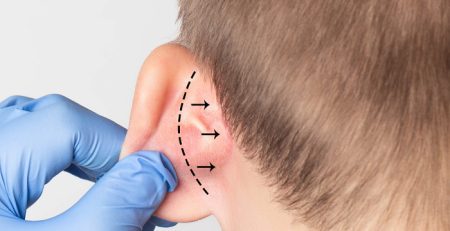
Depending on the surgical method used, an incision may be present on the back surface of the ear, and various suture techniques can be used to hold the ear cartilage in its new position. For this reason, the early period after the surgery is a time when protecting the ear from impact and unnecessary pressure is particularly important.
The temples of glasses, however, are anatomically related to exactly this region. The temples of the frame:
- make contact with the upper edge of the ear,
- sit in the groove behind the ear,
- transfer a portion of the glasses’ weight to the ears,
- can create continuous pressure behind the ear with tight frames.
Under normal circumstances, this pressure does not cause any problems. However, in a newly operated, swollen, and sensitive ear, the same pressure can cause discomfort, redness, or unnecessary compression of the surgical area.
Therefore, the main issue regarding the use of glasses after otoplasty is not so much the question “is wearing glasses forbidden?” but rather “how much pressure do the glasses put on the newly reshaped ear?”
Can Glasses Be Worn in the First Days After Otoplasty?
The first days after prominent ear surgery are generally the most sensitive period. Swelling, slight bruising, tension, and sensitivity to touch may be observed in the ears. The surgeon may apply a dressing, bandage, or headband to protect the ear.
It is stated on the Ear Aesthetics page of Op. Dr. Şükrü İşler Aesthetic Clinic that the ears are protected with a bandage after the surgery, the bandage is changed when necessary in the initial period, and the use of a headband to keep the ear in the proper position is recommended in the subsequent period.
During this period, inserting classic spectacle arms under the bandage or fitting the glasses firmly onto the ears may not be appropriate.
Especially in patients with an incision behind the ear, the spectacle arm resting directly on this area can:
- Increase sensitivity,
- Cause friction in the incision area,
- Create more pressure than normal due to swelling,
- Disrupt the position of the bandage or dressing,
- Place unnecessary mechanical stress on the ear.
Therefore, it is important to inform your surgeon if you constantly wear glasses before the surgery.
How Many Days After Prominent Ear Surgery Can Glasses Be Worn?
There is no single number of days that applies to everyone for resuming normal glasses use after otoplasty.
When evaluating the recovery schedule, the following factors are especially considered:
- The otoplasty technique used in the surgery,
- The extent of cartilage intervention,
- The location of the incision line,
- The suture method used,
- Operating on one or both ears,
- Whether swelling and tenderness persist,
- The healing status of the incision line,
- The weight of the eyeglass frame,
- Whether the eyeglass temples press on the ear.
In some patients, a light and loose pair of glasses can be used carefully at an earlier stage after a surgeon’s check-up, while heavier or tighter frames that put significant pressure on the ear may require a longer waiting period.
Therefore, eyeglass use should not be resumed solely based on a calendar schedule without a doctor’s check-up after the operation.
Is it Harmful for Eyeglass Temples to Press Behind the Ear?
One of the main goals during the early recovery period after otoplasty is to protect the newly shaped ear from unnecessary trauma.
The current Otoplasty – StatPearls review published on NCBI Bookshelf states that early trauma can lead to hematoma or have an adverse effect on the sutures that help maintain the ear’s shape.
This does not mean that everyone who wears glasses will necessarily experience complications. However, a very tight eyeglass temple applying pressure to a newly operated ear for hours can create an unnecessary risk.
Particular caution should be exercised in the following situations:
- If the eyeglass temple is significantly embedded behind the ear,
- If redness persists in the area for a long time after removing the glasses,
- If pain or throbbing increases when wearing glasses,
- If friction is felt along the incision line,
- If the glasses alter the position of the bandage,
- If the ear needs to be pulled forward or outward when putting on glasses.
If one of these symptoms appears, the surgeon who performed the operation should be consulted regarding the manner of using glasses.
What Should I Do If I Have to Wear Prescription Glasses?
This issue is more important for individuals who constantly wear glasses. Especially those who wear high-prescription glasses and cannot perform their daily activities without them must definitely state this before the surgery.
When planning is done before the surgery, the recovery period can be managed more comfortably.
For individuals who are required to wear glasses, according to the surgeon’s evaluation:
- A lighter frame can be preferred,
- A different frame that does not put pressure on the ear can be used temporarily,
- The way the glasses’ temples touch the ear can be adjusted by the optician,
- Individuals who were previously suitable for contact lens use can temporarily wear lenses as per their eye doctor’s recommendation,
- A different temporary usage method tailored to the individual can be planned.
However, methods seen on the internet such as taping, cutting glasses temples, forcibly moving glasses to a different position, or placing various materials on the ear should not be applied without a doctor’s evaluation.
Contact lenses are also not suitable for everyone. Instead of someone who has never used contact lenses before starting to use them on their own solely due to ear surgery, it would be more appropriate to consult an ophthalmologist.
Are Lightweight Frames More Advantageous?
If glasses need to be used in the post-operative period, the weight of the frame and the temple structure can become important.
Thick, heavy, and very tight glasses frames can transfer more load to the ears. Thin and lightweight frames, on the other hand, can create less pressure for some individuals.
However, simply having lightweight glasses is not enough.
Even if a very light pair of glasses has temples that press on the back of the ear, it can still cause discomfort. In contrast, a slightly heavier frame with properly adjusted temples may apply less localized pressure to the ear.
Therefore, when making a choice:
- Frame weight,
- Temple width,
- Tightness of the temples,
- Contact point behind the ear,
- How much of the glasses’ weight the nose bears
should be considered together.
Can Sunglasses Be Worn After Prominent Ear Surgery?
For sunglasses, the basic principle is the same as for prescription glasses.
Whether the lenses of the sunglasses are dark or they are used for aesthetic purposes does not make a difference for the ear. What is important is the mechanical pressure applied by the frame to the ear.
In some sunglasses, the frame and temples may be thicker and heavier than normal prescription glasses. Especially wide plastic frames can apply more pressure behind the ear.
Therefore, there is no general rule like “prescription glasses are forbidden but sunglasses can be worn.”
Patients who wish to use sunglasses after surgery should also consider the recovery schedule recommended by the surgeon.
Can Glasses Be Worn While Using a Headband After Prominent Ear Surgery?
The use of a headband after otoplasty can be part of many surgical protocols. Its purpose is to protect the ear and reduce involuntary trauma, especially during sleep.
However, wearing glasses together with a headband may not be equally comfortable for every patient.
The temples of the glasses:
- Getting under the bandage,
- Being squeezed between the bandage and the ear,
- Increasing the pressure of the bandage at a specific point
can cause discomfort.
For glasses worn over the bandage, the normal position of the glasses may change.
Therefore, how to use the bandage or headband and whether glasses can be worn with it should be demonstrated during the post-operative check-up.
It is not correct to lift, loosen, or move the headband out of the position recommended by the surgeon merely to make room for glasses.
How Long Do Ears Remain Sensitive After Otoplasty?
The reduction of visible swelling from the outside after prominent ear surgery is not the same as the complete healing of the tissues.
Even if a person has largely returned to their daily life within a few weeks, the healing and adaptation process of the ear cartilage and surrounding soft tissues may continue.
The Ear Aesthetics information on Sukruisler.com states that tissue healing can continue for approximately two months, and it is especially important to protect ears shaped with sutures from trauma for a longer period.
Therefore, even if glasses are permitted, in the initial period:
- Not to forcefully put glasses on the ear,
- Not to pull the ear when removing them,
- Not to use very tight frames,
- To have frames that create pressure for a long time checked,
- If discomfort occurs, to discontinue use and consult a doctor
may be beneficial.
Do Glasses Deform the Ear Shape After Prominent Ear Surgery?
This is one of the patients’ most significant concerns.
A standard pair of glasses, used appropriately on an ear that has completed its normal healing and has been cleared for daily use by the surgeon, is not expected to deform the otoplasty result over time.
The risk is more related to excessive pressure or trauma occurring in the early period after surgery, while the ear is still sensitive.
In the study Complications After Prominent Ear Correction: A Systematic Review of the Literature, which examines otoplasty complications, different complications such as hematoma, infection, wound healing problems, suture-related issues, and recurrence were evaluated.
These studies do not identify glasses use as a sole cause of complication. The conclusion to be drawn from this is not “glasses ruin otoplasty.” The truly important point is to protect the surgical area from unnecessary pressure and trauma during the early healing period.
What to Do If You Feel Pain While Wearing Glasses?
Even after post-operative healing has progressed and glasses use is permitted, if significant pain occurs while wearing glasses, this situation should not be ignored.
Especially the following symptoms may require evaluation:
- New onset or progressively increasing pain,
- Significant increase in swelling in one ear,
- Intense redness,
- Increased warmth in the ear,
- Discharge from the incision line,
- Bleeding,
- Wound formation at the glasses’ contact point,
- Noticing a sudden change in ear shape.
Especially progressively increasing pain in the early post-operative period should be evaluated by a doctor.
The current StatPearls Otoplasty source also states that it is important to evaluate increasing pain in the early period for complications such as hematoma.
What to Pay Attention to When Putting On and Taking Off Glasses After Prominent Ear Surgery?
When glasses use is permitted again, not only the time the glasses spend on your face, but also the way they are put on and taken off is important.
Normally, most people can quickly remove their glasses with one hand. However, during this motion, one of the spectacle arms might catch on the ear, pulling the ear forward.
In the post-operative period, it may be more appropriate to put on and take off glasses with both hands in a controlled manner, if possible.
Points to consider are:
- To put on and take off glasses by holding them by both arms,
- Not to pull the arm firmly from behind the ear,
- To avoid movements that fold the ear forward,
- Not to forcefully wedge the frame between the headband,
- To ensure that there are no sharp or rough sections on the spectacle arms,
- To check that the glasses do not rub against the incision line behind the ear.
Is Headphone Use After Otoplasty as Important as Glasses?
Yes. After otoplasty, not only glasses but also other accessories that apply pressure to the ear are important.
Especially large headphones that completely enclose the ear or press the ear towards the head can create significant pressure on the surgical area in the early period.
Similarly:
- Over-ear headphones,
- Sport headphones that go behind the ear,
- Tight helmets,
- Tight hats,
- Headbands that compress the ears,
- Some hearing aids worn behind the ear
may also require a personalized evaluation.
It is especially important for patients who use hearing aids to inform their surgeons about this before the surgery. Since the hearing aid is necessary for daily communication, a post-operative usage plan should be made in advance.
How Should Mask Use Be After Prominent Ear Surgery?
Masks worn with elastic bands behind the ear can also create a mechanical contact similar to glasses.
Especially in the early period after surgery, the elastic touching the incision line behind the ear or pulling the ear forward can cause discomfort.
If an environment where mask use is necessary is in question, it is more appropriate to get information from your doctor about alternative usage methods that do not create pressure behind the ear.
The aim is not to leave the ear completely immobile, but to avoid unnecessary friction, pressure, and pulling forces on the newly operated area.
Is it Problematic for Someone Who Wears Glasses to Undergo Prominent Ear Surgery?
No. Constantly wearing glasses is generally not an obstacle to prominent ear surgery.
A large number of people who wear prescription glasses can undergo otoplasty. The important point here is to plan for glasses use after surgery in advance.
In the pre-surgery consultation:
- Whether glasses are used continuously or only at specific times,
- Whether the glasses prescription is high,
- Whether daily life without glasses is possible,
- Whether contact lenses are used,
- The weight of the frame and the shape of the temples
can be discussed.
This information helps the surgeon tailor the post-surgery daily life plan to the individual.
What is the Healing Process Like in Prominent Ear Surgery?
After otoplasty, the stages of healing vary from person to person.
In the initial period, swelling, slight bruising, tightness, and tenderness may be observed. Dressings and protective bandages may be applied depending on the method preferred by the surgeon.
In the following days, the swelling gradually decreases, and the person starts to return to their daily life. However, starting to look normal from the outside does not mean that the tissues have completely healed.
For this reason, in the first few weeks, not only regarding glasses:
- Sleeping position,
- Sports,
- Hair combing,
- Hair cutting,
- Hat use,
- Headphone use,
- Sea and pool,
- Accessories that touch the ear
caution should also be exercised.
For detailed information on activities such as sea and pool after surgery, you can review the article When Can You Enter the Sea and Pool After Cosmetic Surgery?
How Is the Most Appropriate Time for Glasses Determined After Otoplasty Surgery?
The most appropriate time is determined more by examination findings than by the calendar.
During the doctor’s check-up, the doctor:
- The swelling in the ear,
- The condition of the incision line,
- The position of the cartilage,
- The suture areas,
- The level of sensitivity,
- The contact point of the glasses with the ear
can evaluate.
Therefore, it may be beneficial for individuals who need to wear glasses to come to their follow-up appointment with their own glasses. It can be directly seen which part of the ear the frame touches.
In some patients, readjusting the glasses may be sufficient, while in others, a bit more healing may be expected.
Why Should Post-Otoplasty Care Be Personalized?
Otoplasty does not consist of a single surgical technique.
The recent systematic review titled Otoplasty for Prominent Ear: A Systematic Review of Surgical Techniques, published in 2026, shows that there are numerous different surgical approaches for prominent ear correction and that the techniques used can vary according to the patient’s anatomy.
Similarly, the study Otoplasty Surgical Techniques and Clinical Outcomes: A Practical Review also evaluates the results and complications of different techniques.
Therefore, one person saying on social media, “I wore glasses after 10 days,” does not mean that another patient can safely use glasses on the same day.
The technique used, tissue healing, and the structure of the glasses should be evaluated together.
First Examination or Consultation at Op. Dr. Şükrü İşler Aesthetic Clinic is Free
When planning prominent ear surgery, not only the post-operative appearance of the ears but also the person’s daily life habits should be evaluated.
Especially individuals who constantly use prescription glasses, use hearing aids, need to wear headphones regularly, or are required to use protective eyewear due to their job, should share these circumstances before the surgery.
The first examination or initial consultation at Op. Dr. Şükrü İşler Aesthetic Clinic is free of charge.
During the initial consultation, your ear structure, the characteristics of prominent ear deformity, operation options, post-operative recovery timeline, glasses use, return to work or school, and other daily life issues can be evaluated according to your personal situation.
For information about the place of ear aesthetics within the general proportions of the face, you can review the Facial Aesthetics page, and for other informative content, you can check the Useful Information section.
For a free initial consultation and appointment, you can contact our clinic via the Op. Dr. Şükrü İşler Aesthetic Clinic Contact page.
Brief Answers About Glasses Use After Prominent Ear Surgery
- Can glasses be worn after prominent ear surgery? Yes. However, in the early period, the temples of the glasses should not put pressure on the surgical area, and the time to return to normal use should be determined by the doctor.
- Do glasses impair the otoplasty result? In an ear that has completed its healing, the use of normal and appropriate frames is not expected to impair the result. In the early period, unnecessary pressure and trauma should be avoided.
- Can sunglasses be used? Since sunglasses also apply pressure on the ear, they should be evaluated according to the same principles as prescription glasses.
- Are lightweight frames better? They can often provide an advantage, but the tightness of the temples and the point where they contact the ear are also important.
- I wear glasses, can I have otoplasty? Yes. Wearing glasses alone is not an obstacle to prominent ear surgery.
Frequently Asked Questions
Can I wear glasses immediately after prominent ear surgery?
In the period immediately after the surgery, there may be bandages, swelling, and tenderness in the ears. It may be undesirable for glasses temples to create pressure on this area. If you need to wear glasses continuously, you should inform your surgeon before the operation and learn a suitable temporary usage plan for you.
How many days after otoplasty should glasses not be worn?
There is no single number of days that applies to everyone. The surgical method used, the incision line, swelling, wound healing, and the pressure from the glasses frame can alter the waiting period.
Can I wear glasses after one week?
While this might be possible for some patients, it might be too early for others. It is more appropriate to make a decision during the first-week check-up by evaluating the healing status of the ears and the contact area of the glasses temples.
Is it safe to wear glasses after two weeks?
Two weeks having passed is not a sufficient criterion on its own. If tenderness or significant swelling persists along the incision line, more caution may be needed. Your doctor’s check-up is decisive.
Can eyeglass temples damage stitches after otoplasty?
If the eyeglass temple applies strong, direct pressure to the incision or stitch line, it can cause discomfort and friction. Therefore, the manner in which the eyeglass temple contacts the surgical area should be evaluated.
Can eyeglasses cause the ear to protrude again?
In an ear that has completed its normal healing, the appropriate use of eyeglasses is not expected to cause the ear to protrude again. However, in the early period, movements that constantly pull the ear outwards or create pressure should be avoided.
Can I wear sunglasses after prominent ear surgery?
The same rules apply to sunglasses because their temples also rest on the ear. Especially heavy and thick sunglasses can create more pressure in the early period.
Can eyeglasses be worn over the headband?
While possible for some patients, eyeglasses should not constrict the headband or the operated ear. The position of the bandage should not be altered solely to make room for eyeglasses.
Can I use contact lenses after otoplasty?
It can be a temporary option for individuals who were previously suitable for contact lens use. However, contact lenses are not suitable for everyone, and an ophthalmologist’s recommendation should be sought regarding their use.
Is it normal if my ear hurts when I wear eyeglasses?
Mild tenderness may be observed in the early period of recovery, but pain that becomes more prominent or progressively worsens with glasses should be evaluated. You should especially contact your doctor if it is accompanied by swelling, redness, or discharge.
When can headphones be used after ear pinning surgery?
The timing for using large headphones that press on the ear, like glasses, varies from person to person. It may not be recommended to use tight over-ear headphones before the ear has completely healed.
Can I use work glasses or safety glasses after surgery?
Individuals who are required to wear safety glasses for work must inform this before the surgery. Since safety glasses can be heavier or tighter than normal frames, the return-to-work plan can be made accordingly.
Can ear pinning surgery be performed on children who wear glasses?
Wearing glasses in children alone is not an obstacle to otoplasty. However, whether it is possible for the child to be without glasses and the contact of the glasses’ temples with the surgical area should be planned before the surgery.
How long does recovery from ear pinning surgery take?
Returning to daily life and the complete healing of tissues are different processes. Swelling may significantly decrease in the first few weeks, but the process of ear tissue healing and adaptation to the new shape continues for a longer period.
Is the initial consultation charged?
At Op. Dr. Şükrü İşler Aesthetic Clinic, the initial examination or first consultation is free of charge. Ear pinning surgery, glasses use after otoplasty, the recovery process, and your personal expectations can be evaluated during the first consultation.
Academic Resources
- Kennedy KL, Hohman MH, Katrib Z. Otoplasty. StatPearls / NCBI Bookshelf.
- Thomson H, Gosden J, Mandal A. Otoplasty for Prominent Ear: A Systematic Review of Surgical Techniques. JPRAS Open. 2026.
- Complications After Prominent Ear Correction: A Systematic Review of the Literature.
- Otoplasty Surgical Techniques and Clinical Outcomes: A Practical Review.
- Outcomes and Complications of the Mustardé Otoplasty: A “Good–Fast–Cheap” Technique for the Prominent Ear Deformity.
Is it possible to wear glasses after prominent ear surgery?
Yes. Undergoing prominent ear surgery does not mean you have to give up continuous use of glasses. Glasses can be worn again after otoplasty. However, in the early period after the operation, it is important to protect the newly shaped ears from excessive pressure, friction, and trauma.
Therefore, the main question is not “can glasses be worn?”, but should be “when and how should I use my glasses, considering my surgical technique, healing status, and the frame I use?”
Especially if you continuously use prescription glasses, work glasses, sunglasses, a hearing aid, or any other equipment that touches the ear, sharing this with your doctor before the surgery ensures a more accurate planning of the recovery process.
The first examination or initial consultation at Op. Dr. Şükrü İşler Aesthetic Clinic is free of charge. If you are considering prominent ear aesthetics, your ear structure, surgical options, use of glasses after the operation, and your recovery process back to daily life can be personally evaluated.
For detailed information and a free initial consultation, you can use the contact and appointment page.
This content has been prepared for general informational purposes. Information found on the internet does not replace a personal medical examination and the recommendations of the operating physician.